Pricing approach comparison
prAIcing vs. Rule-Based Shopify Repricers
For Shopify merchants, price matching and price testing solve different problems. Compare an automated competitor response with evidence from shoppers buying in your own store.
Selling a distinct product rather than an identical commodity?
Your brand, delivery, product quality and customer experience can change willingness to pay. A competitor match rule cannot, by itself, tell you how your own shoppers respond to a higher or lower price. A Shopify price test measures that tradeoff.
Rules execute a strategy
“Stay below a chosen competitor, but above my floor” is a clear instruction. A repricer can automate that response without you adjusting every price by hand.
Tests evaluate an assumption
“Could a higher price earn more per visitor?” is a question. prAIcing compares shopper groups to help answer it, inside the limits you set.
Compare the workflow, not the buzzwords
Representative rule-based workflows are shown below. Capabilities overlap: rules can protect margins, and some vendors also offer experimentation.
Primary job
Rule-based repricingMaintain the market position or pricing rule you choose.
prAIcingCompare a current price with a test price against your business objective.
Decision evidence
Rule-based repricingCompetitor offers, costs, stock or other configured inputs; features vary by tool.
prAIcingControlled shopper experiments, measured per product-page visitor; competitor prices can add context.
Margin controls
Rule-based repricingMany repricers support floors, ceilings and change limits. Check the vendor’s implementation.
prAIcingConfigure cost-backed minimum margins, step limits, price rounding and locked products.
Merchant control
Rule-based repricingRule editing, schedules and approval options depend on the product.
prAIcingChoose Observe, Recommend or Autopilot; review activity and stop tests when needed.
When evidence is weak
Rule-based repricingA rule can still act if its configured conditions are met.
prAIcingAn inconclusive result is not a proven winner. Low traffic can limit useful testing.
Best-fit question
Rule-based repricing“How do I stay within my chosen competitive price position?”
prAIcing“Which price produces a better outcome with my own shoppers?”
See the pricing decisions, not just the new price
Review experiments, merchant limits and the activity trail in one place. Chat with the agent in prAIcing, or use the supported Claude and ChatGPT connection for a connected workflow.
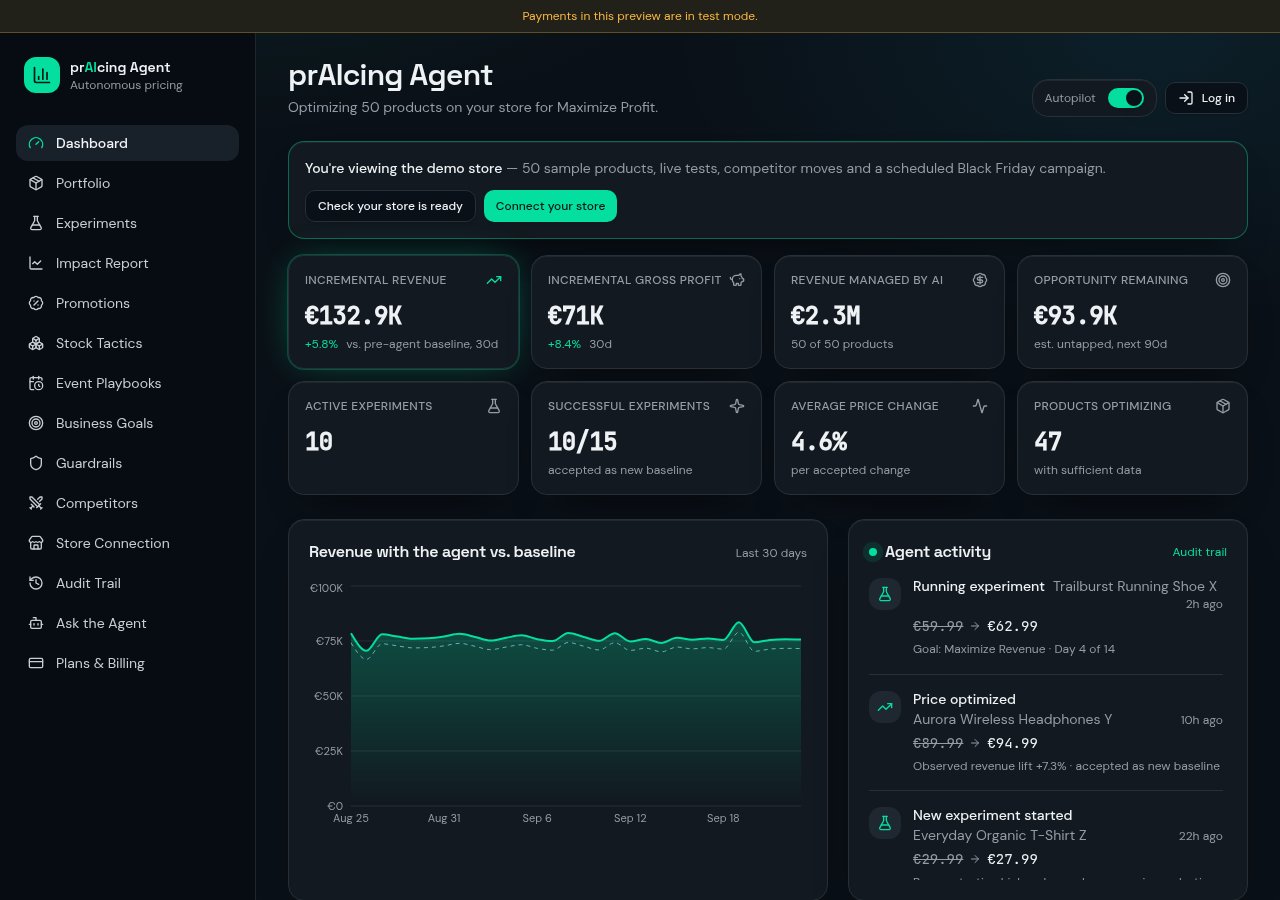
From an assumption to shopper evidence
Your shoppers reveal the tradeoff. Your agent does the work.
A guessed elasticity can make a discount look attractive when it actually destroys margin. prAIcing compares two prices in a controlled 50/50 test and measures revenue or profit per product-page visitor. That evidence informs the next pricing decision — not a competitor’s price alone.
01 · Set the objective
Maximize Sales, Profit or Volume. Define minimum margins, step limits and locked products.
02 · Test & measure
Compare concurrent shopper groups. Measure outcomes per visitor so unequal traffic does not masquerade as demand.
03 · Learn & retest
Roll out a supported winner or keep the original. Revisit the decision as demand and seasons change.
04 · Work across the catalogue
A catalogue with 1,000+ SKUs needs prioritization, not 1,000 manual spreadsheets. Focus tests on products with enough traffic, then work through the queue.
Scale, honestly: current Autopilot runs up to 3 simultaneous tests per store. Catalogue size is not concurrent test capacity; traffic and test duration determine throughput. This is a rolling testing workflow, not a claim that thousands of SKUs have been tested simultaneously or that every product will improve.
Explore the testing methodBefore switching tools
Keep your limits
Enter accurate costs and set minimum margins, change limits and excluded products. Start with recommendations if you want to approve changes.
Choose a testable product
Use a product with enough traffic and available stock. Avoid overlapping promotions or another repricer changing its price during the experiment.
Validate your storefront
Authorize the Shopify connection, enable the theme embed and save it. Check product, cart and checkout behavior before a wider rollout.
Common questions
Is prAIcing a competitor price-matching repricer?
Its central workflow is goal-led price experimentation, not simply matching or undercutting an external price. Competitor tracking can inform a decision, but your shoppers’ measured response is the evidence for a test outcome.
Do all rule-based repricers lack A/B testing or AI?
No. Some pricing tools combine rules, AI and experiments. This comparison describes workflows, not a universal feature verdict. Check each vendor’s current documentation for its testing method, controls and platform support.
Can pricing rules and experiments work together?
They can serve different purposes, but do not let two tools change the same tested product simultaneously. Keep promotions, other repricers and cache behavior under control so the result can be interpreted.
Will a price test guarantee more profit?
No. A test can favor the original price or remain inconclusive. Profit-focused decisions also require accurate product costs. Limited traffic, stockouts, seasonality and conflicting price changes can reduce the usefulness of a test.
What setup is required on Shopify?
Connect your Shopify store and authorize the app. Enable the prAIcing Theme App Extension embed and save it in your live theme before testing. Setup does not require manually editing theme code, but the activation step is required. See the reviewer guide for the current install walkthrough.
Sources & comparison scope
Reviewed November 5, 2026. This is an approach comparison, not an independent benchmark or a subscription-price comparison. Vendor documentation supports the examples; features and availability can change.
- Pricebeeper: rule-based repricing and safeguards — competitor strategies, floors and ceilings.
- WooCommerce: Dynamic Pricing documentation — quantity, role and category discount rules.
- Shopify: price experiment documentation — an example of platform experimentation; availability may be restricted.
Give your pricing question a measurable answer
Set your goal and limits. Let the agent handle the testing cycle, while you focus on your next collection, customer experience or growth initiative.
Private beta · WooCommerce & Shopify · 30 days free once admitted